Submitted by admin on November 12th, 2026
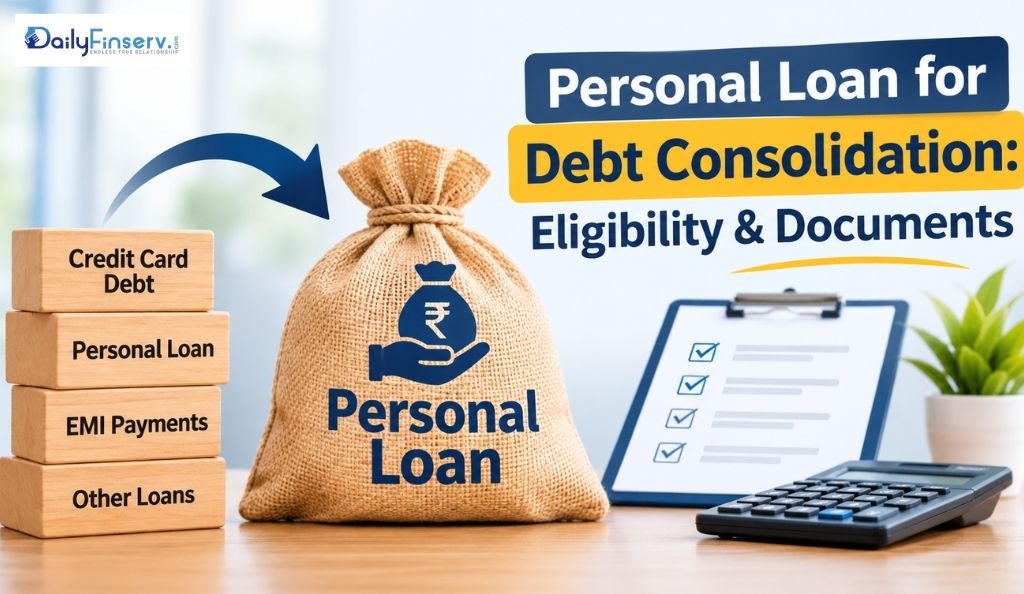
Multiple loans and credit card payments may place a strain on your monthly finances. If multiple due dates, interest rates and EMIs are hard to handle, a personal loan for debt consolidation might be advisable.
A debt consolidation loan is a loan that lets you get rid of a number of loans that you have and put them into one loan. This assumes that you meet the requirements and the loan provider’s terms and conditions.
One can just settle one EMI each month rather than a number of repayments. The personal loan for debt consolidation, however, should come with appropriate interest rates and terms that, with affordability and reasonable charges, make financial sense.
They will depend on the individual lender’s policies and the individual’s financial profile. It is before approving an application, lenders will look at your income, employment stability, current EMIs and credit history.
Good CIBIL score: A positive credit score will increase the likelihood of approval.
Existing obligations: The lenders check your current loans, credit card repayments and repayment history.
Just because the basic debt consolidation loan eligibility is met does not mean that you will be approved. Always work out the amount you have to pay back and if the proposed EMI is comfortably within your monthly budget before applying.
Having the necessary documents ready beforehand can make the application process go more smoothly. The debt consolidation loan documents are having different lenders have different needs, but most personal loan applications will ask for documentation of identity, address and income.
Common documents include:
The lender might ask for other documents based on your employment status, amount of loan and your financial profile. You can review the present document checklist prior to applying.
After the loan, put the money towards paying off the debts you were supposed to consolidate. Ensure that the old accounts are paid as per the requirements and keep making the pending payments on time.
A personal loan is typically an unsecured loan and can be applied for to consolidate eligible outstanding loans. This generally doesn’t require that you pledge any property or other asset as collateral but will be subject to the lender’s evaluation.
But the new EMI will be based on the loan amount, interest rate and tenure. The monthly payment may be lower, but there would be more interest paid over the longer period of time. The savings can change if the processing fee or foreclosure fee on an existing loan is incurred.
Prior to consolidation, compare the total dollar amount of your existing loan to the dollar amount of the proposed consolidated loans with a personal loan. The only time consolidation is helpful is when the new arrangement is better aligned with your financial objectives.
For people who have a number of loans, personal loans in India are an option they can consider. They can avail loans from banks or non banking financial companies (NBFCs). But not all lenders have a special loan for debt consolidation in India and how the loan proceeds can be used varies from lender to lender.
When selecting a lender, keep these things in mind:
Interest rate: Do not only consider starting rates, but the rate offered to you.
Processing fees: Make sure to factor in processing fees and taxes.
Repayment period: Choose a period of repayment that fits within your means and minimizes the amount of interest paid.
Repayment charges: See if you can pay off the loan sooner and if there is any prepayment fee.
The Loan Amount: The approved loan amount is sufficient to repay the debts that you want to settle.
Lender credibility: Check the lender’s credentials, terms, grievance redressal process, etc.
One should also see if it would be better to merge their current loans or not. It could be that you are borrowing more without making your spending changes, and as such, you will have more debt to cover.
If you pay for your credit card balance from one bill to the next, it can cost you a lot of money. Interest and other charges may keep building up and it might be hard to pay back.
You could obtain a personal loan to pay off your credit card debt, and set up a schedule for repaying that debt. The personal loan to pay credit card debt might have a lower rate of interest compared to the actual cost of maintaining the credit card debt.
When considering a personal loan, be sure to check out the interest rate, fees, and the amount of the loan you will have to pay back in the end, when compared with the interest rate, fees, and total repayment you are paying on your current credit card debt.
Take the following precautions into account:
Taking a personal loan to pay off a credit card is not a guaranteed way to boost CIBIL score. Repayment pattern, outstanding balances and new credit applications will still impact your credit profile.
In most cases, the debt consolidation loan process starts with evaluating existing debts and culminates with the servicing of these debts with the new loan.
Step 1: Evaluate the debt you owe: Sum up the amounts you owe on each of your personal loans, credit cards and eligible debt.
Step 2: Do a financial review: Review your monthly income and your existing monthly expenses and EMIs to figure out how much you can afford to pay back.
Step 3: Comparisons: Consider the interest rates, processing fees, duration of repayment and other relevant fees.
Step 4: Fill out the application: You can submit the application and the paperwork that the lender needs.
Step 5: The verification process: The lender verifies your income, credit history, employment and repayment capability.
There are different approval processes and disbursement timeframes for different lenders. Applications may be processed quickly and further verification.
A personal loan for debt consolidation is a loan that’s used to pay off a bunch of loans or debts, including personal loans or credit card balances.
An individual who has several loans outstanding, a steady income and is having trouble keeping track of several payments might want to consolidate their loans.
It is generally, eligibility is based upon age, income, employment or business stability, credit history and existing financial obligations.
The CIBIL score requirement for all debt consolidation loans in India is different. There are lenders who would prefer to have a credit score that’s 750 or even higher, others might take different credit scores.
The PAN, identity and address proof, bank statements and proof of income are common requirements.
A personal loan can typically be utilized for credit card bill payments, but it depends on the terms and conditions of the lender.
It varies depending on the lender’s maximum loan amount, income, credit score, other EMIs and repayment power.
The process takes different lengths with different lenders and applications. It depends on the personal loan provider; some loans can be approved in as little as 24 hours.
You can find and compare the interest rate, processing fee, EMI, repayment period, prepayment terms and total repayment.
DailyFinserv can educate you on debt consolidation choices, the key considerations for eligibility and what types of papers you might require for an application.
Int Rates : 10.5% - 22%
Loan Amount: ₹ 1,00,000.00
Maximum Tenure - 7 Years
Lowest EMI : ₹ 1,686
Interest Rate 13.99% - 24.99%
Loan Amount: ₹ 1,00,000.00
Maximum Tenure – 5 Years
Lowest EMI : ₹ 2,326
Interest Rate 9% - 13%
Loan Amount: ₹ 1,00,000.00
Maximum Tenure – 20 Years
Lowest EMI : ₹ 1,014
Interest Rate 8.40% - 12%
Loan Amount : ₹ 1,00,000.00
Maximum Tenure – 35 Years
Lowest EMI – ₹ 739
