Submitted by admin on June 9th, 2026
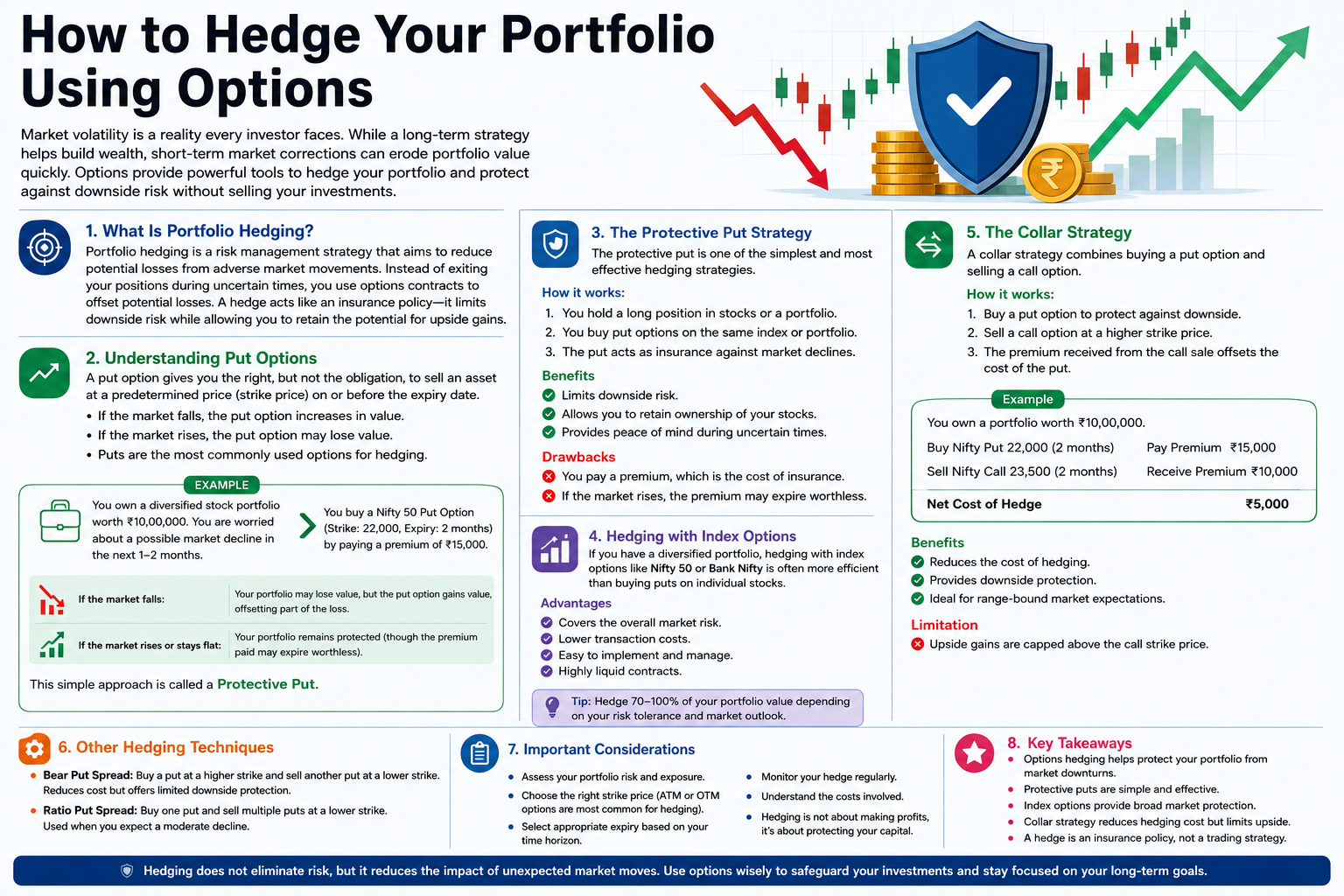
A portfolio hedging strategy is a risk management technique aimed at minimizing the risk of potential losses given an adverse market situation. Rather than selling investments in times of uncertainty, investors can also choose to use options contracts to cap their losses while still holding on to potential profits.
Although a hedge does not completely remove risk, it may help to mitigate losses during downturns in the market.
The most frequently used hedging instrument is a “put option. A put option is one of the most widely used hedging instruments. A put option is an option contract that provides the buyer with the right, but not the obligation, to terminate a contract and receive the fixed price (called the strike price) for a purchased asset prior to the expiration date of the option.
When the market drops, the put option will typically gain in value, which will offset the losses in the underlying portfolio.
Now, imagine that a trader has a stock portfolio with ₹5 lakhs invested in various stocks. The investor buys a put option on Nifty 50 as he is apprehensive about the possibility of a short-term fluctuation in the markets.
One of the easiest and best hedging strategies is the protective put.
A large number of investors have diversified portfolios that closely mimic the overall market. Hedging can be done by purchasing put options on the index of stocks, like purchasing Nifty or Bank Nifty options as opposed to purchasing individual stock put options.
One of the reasons why many institutional investors and professional portfolio managers use index options is because they provide exposure to the market as opposed to just a single stock.
A more popular hedging approach is the collar strategy.
The investor purchases a put option that serves as a protection.
The premium takes the place of the premium needed to be paid to buy the put.
Options may be useful when it comes time to safeguard investment portfolios in times of uncertainty. Protective put, index-option hedging and collars are some of the strategies used to control downside risk while not having to sell shares outright.
Int Rates : 10.5% - 22%
Loan Amount: ₹ 1,00,000.00
Maximum Tenure - 7 Years
Lowest EMI : ₹ 1,686
Interest Rate 13.99% - 24.99%
Loan Amount: ₹ 1,00,000.00
Maximum Tenure – 5 Years
Lowest EMI : ₹ 2,326
Interest Rate 9% - 13%
Loan Amount: ₹ 1,00,000.00
Maximum Tenure – 20 Years
Lowest EMI : ₹ 1,014
Interest Rate 8.40% - 12%
Loan Amount : ₹ 1,00,000.00
Maximum Tenure – 35 Years
Lowest EMI – ₹ 739
