Submitted by admin on May 8th, 2026
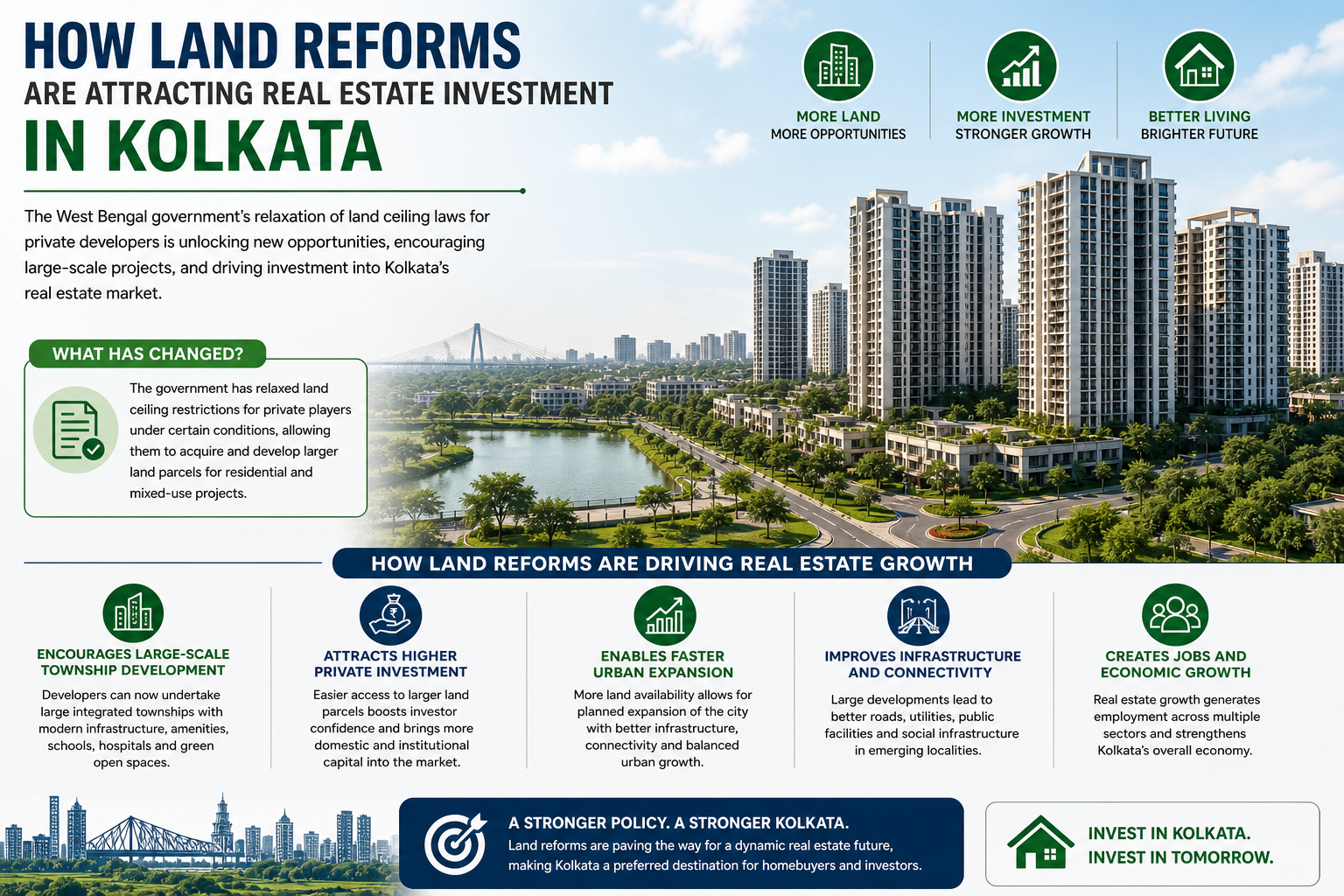
The real estate business in Kolkata is experiencing a fresh wave of growth with the government of West Bengal lifting the laws on land ceiling. Historically, land ceiling laws put a cap on the size of the land that could be possessed by an individual or a private company, which frequently limited large-scale real estate development.
The initial introduction of land ceiling laws was to counteract land hoarding and to allow equitable distribution. But in the city such as Kolkata these limitations tended to act as a hindrance to the developers seeking to construct integrated housing developments. The recent liberalization enables developers to obtain and exploit bigger land areas, as long as there are regulatory approvals and compliance.
The stimulation of large-scale projects in townships can be considered one of the most immediate effects of the reform. Developers are now able to plan large residential developments that will not only include residential houses but will also include other amenities like schools, healthcare facilities, retail spaces and green zones. Such integrated developments are becoming more popular among the homebuyers who are in need of better quality of life. Specifically, New Town, Rajarhat, and the EM Bypass corridor are areas that are likely to experience a boom of such projects making them modern urban centers.
The repeal of the laws on land ceiling sends a resounding message to those in charge of investments and real estate development that the state is serious about its efforts to create a business-friendly environment. With less limitations on the acquisition of land, the private players are more ready to invest in such big projects that have long-term returns. Both the domestic/ institutional investors are also likely to show more interest in the Kolkata real estate market which has traditionally been cheaper as compared to other metropolitan cities.
The reform enables urban expansion to be done more quickly and in an organized way, by providing the developers with access to larger land banks. As opposed to small-scale, fragmented development, the emphasis can be developed on planned growth with adequate infrastructure and connectivity. This is especially significant to a city of increasing population such as Kolkata where the population pressures are gradually rising.
Massive real estate investments are usually accompanied by the development of infrastructure. In conjunction with the government, developers help in the construction of roads, drainage, and utility networks within and surrounding their projects. Lifestyle amenities like parks, clubhouses, security facilities are also present in modern townships making them appealing to buyers and investors alike.
Although the reforms are opening up opportunities, a balance between development and regulation is still significant. The government should see to it that acquisition and use of land are guided by transparent procedures and are not associated with speculative activities and environmental issues.
The decision to relax land ceiling laws is a big change in the real estate policy structure in Kolkata. These reforms are laying the foundation towards an ever-dynamism and investor-friendly market. When properly implemented with a robust governance and infrastructure support, the policy can serve a central role to make Kolkata a competitive real estate destination over the next few years.
Int Rates : 10.5% - 22%
Loan Amount: ₹ 1,00,000.00
Maximum Tenure - 7 Years
Lowest EMI : ₹ 1,686
Interest Rate 13.99% - 24.99%
Loan Amount: ₹ 1,00,000.00
Maximum Tenure – 5 Years
Lowest EMI : ₹ 2,326
Interest Rate 9% - 13%
Loan Amount: ₹ 1,00,000.00
Maximum Tenure – 20 Years
Lowest EMI : ₹ 1,014
Interest Rate 8.40% - 12%
Loan Amount : ₹ 1,00,000.00
Maximum Tenure – 35 Years
Lowest EMI – ₹ 739
